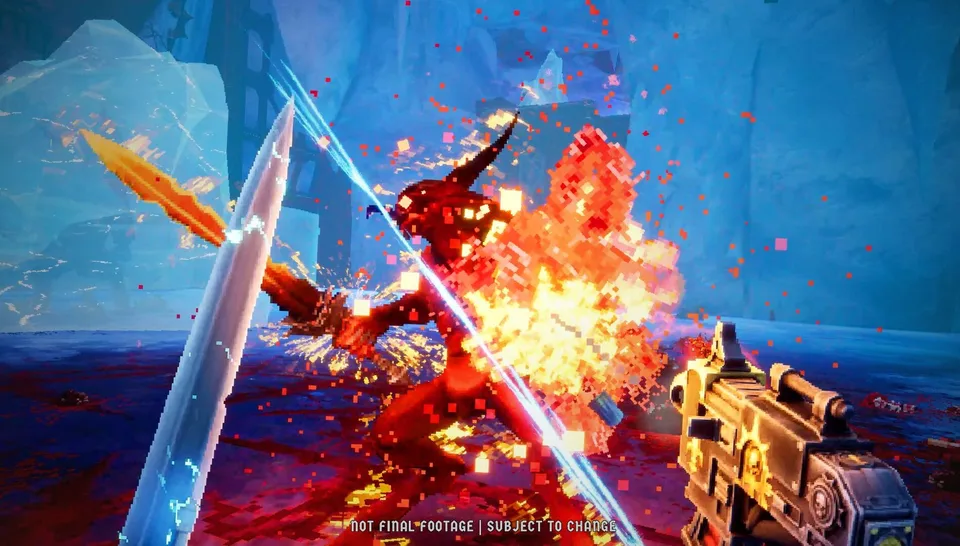
Understanding the Greater Daemon Threat in Boltgun 2
When diving into the explosive retro shooter landscape of Boltgun 2, players quickly realize that the scale of corruption has grown far beyond the borders of the original game. According to developer insights shared on the PlayStation Blog, the sequel introduces a massive escalation in demonic forces. Central to this crisis is Vashtorr the Arkifane, a powerful demon prince of chaos whose actions drive the narrative forward across isolated star systems and corrupted hive worlds.
For veterans tracking the lore and combat challenges, understanding how these greater daemon factions operate is essential for survival. Whether you choose to play as returning veteran Malum Caedo or the swift Adepta Sororitas newcomer Kyra Valeroth, knowing your enemy dictates your loadout strategy. Below, we break down the terrifying new host of adversaries waiting in the upcoming campaign.
Vashtorr the Arkifane and the Chaos Uprising
The storyline picks up immediately after the events of the first game, plunging the protagonists into a massive warp-fueled crisis. Vashtorr activates a colossal demonic machine that cripples the Imperial Fleet, spreading the war across multiple worlds.
Community reports and official trailers indicate that Vashtorr functions as the primary overarching threat of the campaign. Lead designer Matt Bone noted that the team wanted to expand the scope by giving every major Chaos power a distinct presence on the battlefield, making the conflict feel like a true interstellar crusade rather than a localized skirmish.
Vashtorr's Impact
Narrative Anchor: Triggers the systemic chaos surge across isolated star systems.
Strategic Scale: Disables the Imperial Fleet, forcing Malum Caedo and Kyra Valeroth into deep-zone investigations.
Final Threat: Backed by dedicated title cards and heavy narrative framing in release trailers.
The Four Chaos Factions and Their Elite Units
Unlike its predecessor, Boltgun 2 introduces all four Chaos god factions into the roster. Each faction brings distinct gameplay loops, forcing players to adapt their heavy weaponry—such as Kyra's heavy flamer or Malum's plasma rifle—to entirely different combat pressures.
Slaanesh: The Elusive Daemonettes
Representing the speed and sensory overload of Slaanesh, Daemonettes are designed to disorient players. According to lead artist Mark Chambers, the development team utilized specialized freeze-frame techniques to capture sprite trails during their lightning-fast phase attacks.
Tip
Combat Tip: Daemonettes perform large arcing leaps and zigzagging attacks that can crowd control an unwary player. Use rapid movement or area-denial weapons to keep them at a distance before they close in for close-range claw strikes.
Khorne: Bloodcrushers and Berserkers
Khorne brings relentless physical pressure through mounted units and aggressive infantry. The Bloodcrusher represents a major technical milestone as the first mounted unit in the series.
Identify the Mount: Watch out for the Juggernaut's devastating charge ability, which functions like a daemonic runaway train.
Manage Dismounted Foes: When the Bloodletter rider leaps off the mount, you must eliminate two distinct threats instead of one.
Prevent Corpse Consumption: Juggernauts possess a recovery mechanic where they gorge on nearby battlefield corpses—including their former riders—to regain health.
Nurgle: Pestilent Terminators
Nurgle focuses heavily on area-denial gameplay. Alongside returning Plague Marines, players must face Blightlord Terminators. These heavily armored units act as walking plague factories, launching blight grenades and slamming massive corrupt flails into the ground to create hazardous zones. Players relying on close-range combat, such as Kyra's sword work, must time their engagements carefully to avoid lingering toxic residue.
Tzeentch: Bullet Hell with Scarab Occult Terminators
Tzeentch shifts the combat dynamic toward projectile-heavy encounters. The inclusion of Rubric Marines and Scarab Occult Terminators introduces a distinct bullet-hell flavor. One notable terminator carries a Hellfyre Missile Rack, unleashing a rapid deluge of micro-missiles that forces players to master vertical agility and quick positioning.
Allied Reinforcements: The Death Korps of Krieg
For the first time in the series, players will not be entirely alone in their purge of the heretic. Community previews and official reveals confirm that Astra Militarum units from the Death Korps of Krieg will fight alongside the protagonists in several levels.
Adorned in their iconic gas masks and trench coats, these loyal guardsmen provide valuable backup fire using standard lasguns. However, consistent with the grimdark setting of the universe, their life expectancy in frontline firefights remains remarkably low, meaning they serve best as temporary distractions rather than reliable bodyguards.
Frequently Asked Questions
Is Boltgun 2 a direct sequel?
Yes, the story picks up straight from the end of the first game, following the surge of Chaos activity across an isolated star system.
Can I play as different characters in the campaign?
Yes, you can choose between returning veteran Malum Caedo, who relies on heavy hitting and brute force, and the agile new Sister of Battle, Kyra Valeroth, who excels at close-range blade work and fire.
Which platforms are supported at launch?
The game launches on PC, PlayStation 5, and Xbox Series X/S, with a Nintendo Switch 2 version planned for a later date.